

What Animal Has The Highest Mortality Rate

Map showing the approximate world distribution of snakes.

Map showing the global distribution of snakebite morbidity.
Virtually snakebites are caused by non-venomous snakes. Of the roughly three,700 known species of ophidian found worldwide, only 15% are considered unsafe to humans.[1] [2] [3] Snakes are found on every continent except Antarctica.[ane] At that place are two major families of venomous snakes, Elapidae and Viperidae. 3 hundred xx five species in 61 genera are recognized in the family Elapidae[4] and 224 species in 22 genera are recognized in the family Viperidae,[five] In addition, the most diverse and widely distributed ophidian family, the colubrids, has approximately 700 venomous species,[6] but just v genera—boomslangs, twig snakes, keelback snakes, green snakes, and slender snakes—take caused human fatalities.[6]
Since reporting is non mandatory in many regions of the earth,[1] snakebites oft become unreported. Consequently, no accurate written report has e'er been conducted to determine the frequency of snakebites on the international level. However, some estimates put the number at one.two to 5.5 million snakebites, 421,000 envenomings, resulting in perhaps 20,000 deaths, just the bodily number of deaths may be as loftier every bit 94,000.[7] Many people who survive bites notwithstanding endure from permanent tissue damage caused by venom, leading to disability.[8] Most snake envenomings and fatalities occur in South asia, Southeast Asia, and sub-Saharan Africa, with India reporting the most snakebite deaths of any country.[1] An assay cross-referencing exposure to venomous snakes and accessibility of medical handling identified that 93 million people worldwide are highly vulnerable to dying from snakebite.[9]
Worldwide, snakebites occur almost frequently in the summer season when snakes are active and humans are outdoors.[1] [ten] Agricultural and tropical regions report more than snakebites than anywhere else.[1] [11] In North America, the victims are typically male and between 17 and 27 years of age.[ii] [ten] [12] Children and the elderly are the most likely to dice.[2] [13]
| Region | Low Estimate | High Estimate |
|---|---|---|
| Asia | 237,379 | 1,184,550 |
| Australasia | i,099 | 1,260 |
| Caribbean area | 1,098 | 8,039 |
| Europe | three,961 | 9,902 |
| Latin America | 80,329 | 129,084 |
| Northward Africa / Middle Eastward | 3,017 | 80,191 |
| North America | 2,683 | iii,858 |
| Oceania | 361 | 4,635 |
| Sub-Saharan Africa | 90,622 | 419,639 |
| Total: | 420,549 | 1,841,158 |
| Region | Low Estimate | High Estimate |
|---|---|---|
| Asia | 15,385 | 57,636 |
| Australasia | 2 | 4 |
| Caribbean area | 107 | 1,161 |
| Europe | 48 | 128 |
| Latin America | 540 | 2,298 |
| North Africa / Eye Due east | 43 | 78 |
| North America | v | 7 |
| Oceania | 227 | 516 |
| Sub-Saharan Africa | 3,529 | 32,117 |
| Total: | nineteen,886 | 93,945 |
Africa [edit]
Although Africa is home to four venomous snake families—Atractaspididae, Colubridae, Elapidae, and Viperidae—approximately 60% of all bites are caused past vipers alone. In drier regions of the continent, such every bit sahels and savannas, the saw-scaled vipers inflict up to 90% of all bites.[14] The puff adder is responsible for the most fatalities overall,[15] although saw-scaled vipers (Echis spp) inflict more bites in Northward African countries, where the puff adder is typically non institute.[eleven] Dendroaspis polylepis is classified as the serpent of highest medical importance by the Globe Health Organisation in Africa.[a] [sixteen] The black mamba (Dendroaspis polylepis), although responsible for fewer snakebite incidents, is the species which has the highest mortality rate in Africa and in the globe (per capita) if left untreated. Earlier the advent of a polyvalent antivenom produced by the South African Institute for Medical Research, black mamba envenomation was certain to cause fatality (100% rate).[17] [xi] [18] [nineteen]
Most bites occur in industrial plantations, which attract many types of snake prey. Banana plantations are associated with vipers such as night adders, while safe and palm tree plantations attract elapids, including cobras and black mambas.[18] Important African cobra species include the Greatcoat cobra and the black-necked spitting cobra.[20] In forested areas of Guinea, cobras may inflict more than 30% of all venomous bites.[21]
Mambas, cobras, and some larger puff adder species may claim territories of upwards to one to 2 square kilometres (0.4 to 0.8 sq mi), which are used past the snakes for hunting and reproduction. These snakes are big enough to defend their territory from intruders, including humans.[xiv] The black mamba, in particular, is among the most venomous snakes in the globe and one of the most ambitious. It is the longest ophidian on the continent and is able to move at 11 kilometres per hour (6.8 mph), making it unusually unsafe.[22] Although black mambas cause merely 0.5-1% of snakebites in South Africa, they produce the highest mortality rate and the species is responsible for many snake bite fatalities. The black mamba is the species with the highest mortality charge per unit in every single nation in which it occurs, despite non being responsible for the most numerous snakebites. It is too the species which has the highest mortality rate worldwide.[17] Although antivenom saves many lives, mortality due to black mamba envenomation is still at 14%, even with antivenom treatment.[23] In improver to antivenom handling, endotracheal intubation and mechanical ventilation are required for supportive therapy.[24] [25]
At that place are also venomous colubrids in Africa, although of these only two arboreal genera, the boomslang and the twig snakes, are likely to inflict life-threatening bites. Of the Atractaspididae, Atractaspis is the species involved in the majority of bites. Since these snakes are nocturnal and fossorial, living in burrows underground, bites remain rare, peaking at ane to 3% in certain areas of the Sudanian savanna. However, in that location is no antivenom or other effective therapy for Atractaspis envenomation, and the case fatality rate remains approximately 10%, with death typically occurring quickly.[26]
Snakebites in Africa are most common in the sub-Saharan countries (scorpion stings are more common in Northern Africa), and typically occur during the rainy season when snakes are more than active.[27] Agricultural plantations and pastoral areas are involved in approximately fifty to 60% of reported snakebites,[21] while outdoor activities such as collecting firewood and water business relationship for another xx% of bites.[fourteen] Approximately 1 million snakebites occur in sub-Saharan Africa each year,[28] resulting in up to 500,000 envenomations, 25,000 deaths and another 25,000 permanent disabilities.[29]
Because there is no reliable reporting system in place and because most victims never report their injury to health care facilities, these numbers are uncertain.[28] One comprehensive study estimates that 91,000 to 420,000 snake envenomings occur in sub-Saharan Africa annually, resulting in anywhere from 4,000 to 30,000 deaths.[1] The same written report estimates that 3,000 to lxxx,000 envenomations occur in North Africa, although far fewer people, less than 100, dice each yr.[1] The variability of these estimates is indicative of the difficulty in accurately assessing snakebite morbidity and bloodshed.
In sub-Saharan Africa, over 50% of snakebite injuries are not appropriately treated.[28] Between 40 and 80% of victims, depending on the land, exclusively rely on traditional medicine for treatment.[28] Most victims who receive handling by wellness care professionals have withal delayed seeking medical attention for over 24 hours, and often upwards to one to 2 weeks.[28] In many sub-Saharan countries, poor availability of expensive antivenom contributes to morbidity, and snakebites continue to remain a neglected health problem.[28]
Asia [edit]
In People's republic of bangladesh, the incidence of snakebites is very loftier, like other tropical countries of Southeast Asia. Here well-nigh snakebite victims abode in rural areas are farmers, fishermen, and hunters and also there are a loftier number of snakebite occurrences that happened at their homes as most of the snakes are nocturnal animals and poor people take the practice of sleeping on the floor. An epidemiological study estimated well-nigh 8000 snakebites per year with 22% bloodshed which has been identified to be one of the highest in the world. Nonetheless, there are approximately fourscore species of snakes found in People's republic of bangladesh; among them merely few are venomous. These are cobra, krait, Russell'southward viper, sawscaled viper, dark-green snakes, and sea snakes. However, most of the bites are reported past nonvenomous snakes and even as many as 40% bites inflicted past venomous snakes do non produce signs of envenoming.[xxx]
On the Indian subcontinent, almost all snakebite deaths have traditionally been attributed to the Big Four, consisting of the Russell'due south viper, Indian cobra, saw-scaled viper, and the common krait. However, studies accept shown that the hump-nosed viper, previously considered essentially harmless and misidentified as the saw-scaled viper, is capable of delivering a fatal bite.[31] [32] In regions of Kerala, Bharat, information technology may be responsible for nearly 10% of venomous bites.[32] Commonly used antivenoms in India do non announced to be effective against hump-nosed viper bites.[31] [32] Co-ordinate to the most conservative estimates, at least 81,000 serpent envenomings and eleven,000 fatalities occur in Bharat each year, making it the virtually heavily affected country in the world.[ane] The Malayan pit viper and banded krait are two other species involved in a significant number of venomous bites.
In Myanmar (Burma), approximately 70 to eighty% of bites are inflicted by the Russell'southward viper, which is frequently institute in rice fields.[33] In Japan, the majority of venomous bites are inflicted past the Asian pit vipers.[33] In Sri Lanka, approximately forty% of bites are caused by the Russell's viper, while 35% are caused by the Indian cobra.[33] In Thailand, the monocled cobra is responsible for the majority of snakebite fatalities.[34] Tea plantations are sometimes associated with elapids such every bit the common cobras and the king cobra.
Reports of big human being-eating pythons are common in Southeast Asia, although the threat is typically exaggerated. However, in the Philippines, more than than a quarter of Aeta men (a modern forest-dwelling hunter-gatherer group) take reported surviving a reticulated python attack.[35] Pythons are nonvenomous deadfall predators, and both the Aeta and pythons hunt deer, wild pigs, and monkeys, making them competitors and prey.[35]
Throughout Western Asia, the species responsible for the majority of bites tend to be more venomous than European snakes, just deaths are exceptional. Studies estimate that perhaps 100 fatal bites occur each year.[1] [18] The Palestine viper and Lebetine viper are the most important species.[18] While larger and more than venomous elapids, such as the Egyptian cobra, are also establish throughout the Middle East, these species inflict fewer bites.
Australasia [edit]

The vast majority of venomous snakebites in Australasia occur in the Australasian realm. At least 300 envenomations occur each year in Papua New Guinea, 30 in the Solomon Islands, and x Vanuatu.[1] The majority of bites in New Republic of guinea are caused by the death adders, and a smaller number by the owned pocket-sized-eyed ophidian and other local species.[36] Near of the Pacific Islands are free of terrestrial snakes, although sea snakes are common in coral reefs. In the Oceanian realm, only Micronesia and Tonga, where at least x envenomations occur annually, face an appreciable burden of snakebite.
In Australia, in that location are many more than annual cases of spiderbite and jellyfish envenomation than snakebite; even so, when considering the number of fatal cases, snakebite is the most serious type of envenoming.[37] Commonwealth of australia is unique in that information technology is the only continent where venomous snakes constitute the majority of species.[38] Nearly all venomous species in Australia are elapids, as vipers are absent-minded from the continent.[37]
The brown snakes, expiry adders, mulga snakes, taipans, and tiger snakes are the v groups that inflict near all reported snakebites, although copperheads, rough-scaled snakes, and members of the genus Hoplocephalus are also occasionally involved in bites. Of the five dangerous groups, the highly venomous eastern brown snake, which is widespread and common in both rural and urban environments, is the well-nigh important—information technology is estimated to be responsible for up to lx% of all deaths caused past snakebite.[38]
In Northern Australia, sea snakes are common and occasionally inflict bites, although far less frequently than terrestrial snakes.[37] Several venomous colubrids exist in Australia every bit well, such as the brown tree snake, although they take geographically express distributions and but very rarely deliver a medically significant bite.[39] In Tasmania and Kangaroo Island, which accept a cooler, moister habitat than mainland Australia, the tiger snakes and copperhead snakes inflict the majority of bites. The brown snakes are not present on these islands.[twoscore]
Despite the fact that many Australian snakes have unusually potent venom, wide access to antivenom, which is bachelor for all dangerous species,[37] has made deaths exceedingly rare. It is believed that upward to i,500 definite or suspected snakebites occur in Australia each year, of which about 200 are serious enough to warrant antivenom therapy.[i] [37] Approximately two to 4 fatalities occur annually.[37]
Europe [edit]
In Europe, nearly all of the snakes responsible for venomous bites belong to the viper family, and of these, the coastal viper, nose-horned viper, asp viper, and Lataste's viper inflict the majority of bites.[xviii] Although Europe has a population of some 731 million people, serpent bites are just responsible for between 1 and 7 (boilerplate of 4) fatalities each year,[41] [42] largely due to wide access to health care services and antivenom, every bit well as the relatively mild potency of many native species' venom.[xviii]
Fifty-fifty in Europe, measurement of the prevalence and mortality due to venomous snakebite is challenging, and most figures are likely underestimates.[42] The best estimate is that the annual incidence of snakebites in Europe (including European Russia and Turkey) is 1.06 [0.97–one.fifteen] per 100,000 inhabitants,[41] only about xv% of which are severe bites. The most detailed information on bloodshed are from France, where 36 people died from venomous snakebite betwixt 1980 and 2008, an annual mortality of 0.0021 per 100,000 inhabitants.[41]
Bites from captive venomous snakes to a very specific and limited population of amateur herpetoculturists, zookeepers, and researchers are an result in Europe,[43] [44] challenging hospital workers with unexpected situations.[45]
N America [edit]
Of the 120 known ethnic snake species in Northward America, but 20 are venomous to human beings, all belonging to the families Viperidae and Elapidae.[2] However, in the United States, every state except Maine, Alaska, and Hawaii is habitation to at least one of twenty venomous snake species.[2] Upwards to 95% of all snakebite-related deaths in the Us are attributed to the western and eastern diamondback rattlesnakes.[ii] [46] Further, the majority of bites in the Usa occur in the southwestern part of the country, in part because rattlesnake populations in the eastern states are much lower.[47]
The national boilerplate incidence of venomous ophidian bites in the U.s.a. is roughly 4 bites per 100,000 persons,[48] and almost 5 deaths per yr total (1 death per 65 one thousand thousand people).[49] The state of North Carolina has the highest frequency of reported snakebites, averaging approximately xix bites per 100,000 persons.[48] Fewer than ane% of venomous snakebites in the United States are acquired by coral snakes,[50] the rest being caused by the pit vipers (rattlesnakes, copperheads, and cottonmouths).
United mexican states is estimated to have at least 28,000 snake envenomings annually, although only a small number of these lead to death.[ane] Central America is habitation to 23 species of pit vipers, and they inflict the vast majority of reported bites. Of these, Bothrops asper is the about important species, partly because it is abundant in lowland areas and partly because information technology is frequently found in agronomical and pastoral areas where humans work. Of the elapids, the yellow-bellied sea ophidian has, very rarely, acquired venomous bites, while the coral snakes, although mutual, inflict but 1 to 2% of all reported snake bites.[51] Of the coral snakes, Micrurus nigrocinctus is responsible for the most bites.[52]
Colubrid species found in Cardinal America simply crusade mild to moderate envenomation in healthy adults, and most of these bites have occurred in humans treatment the snakes.[52] Panama may have the greatest incidence of snakebites in Latin America, while El Salvador has the lowest (mostly because B. asper is not institute in this country).[53] The total number of snakebites in Primal America is estimated to be 4,000 to 5,000, although as in other regions of the world, snakebites are probably underreported.[53]
Due south America [edit]
In the Neotropics, the lance-headed vipers inflict the majority of fatal bites, although of the many known species, simply 2, the common lancehead and terciopelo, are responsible for most fatalities.[viii] [eleven] The tropical rattlesnake is some other important species.
Venomous snakebite in Primal and South America was reviewed extensively by Warrell.[54] Estimates of the number of deaths resulting from venomous snakebite based on hospital and Ministry of Health data are underestimates and "notoriously inaccurate",[54] ranging from iii,000-four,000 deaths estimated in 1954[55] to 5,000 deaths out of 300,000 bites in 1998.[eighteen] This is because most people in rural areas seek help of traditional shamans instead of modern hospitals.[54] For instance, 54% of patients admitted to hospitals for venomous snakebite in northwestern Colombia had already been treated past a shaman.[56]
Although snakebite risk may be high, tourists and other visitors are rarely bitten. The chance to field biologists working in Central America is estimated at 1 bite per 500,000 hours of field piece of work.[57] Treatment with antivenom has reduced the bloodshed from due east.thou. tropical rattlesnake bites in Brazil from 72% to 12%.[58]
Amazingly, information from anthropological studies suggest that although snakebite risk and death from snakebite are relatively loftier among forest-home Amerindian groups (two-4% of all deaths depending on the group),[54] [59] [60] [61] [62] the majority of members of some of these groups instead die in conflicts with other humans, either outsiders or other Amerindians.[63]
Oceans [edit]
Most of the Pacific Islands are free of terrestrial snakes;[18] however, sea snakes are common in the Indian Ocean and tropical Pacific Bounding main, just are non found in the Atlantic Ocean or the Caribbean, Mediterranean or Cherry Seas.[64] While the bulk of species live close to shorelines or coral reefs, the fully pelagic yellow-bellied bounding main ophidian can be establish in the open sea.[64] Over l% of bites inflicted past bounding main snakes, which are by and large non aggressive, occur when fishermen attempt to remove snakes which take become tangled in fishing nets.[64] [65]
Symptoms may appear in as little as 5 minutes or take 8 hours to develop, depending on the species and region of the body bitten.[64] Although sea snakes are known for extremely potent venom, well-nigh 80% of reported bites end upward being dry.[64] [66] Information technology is estimated that each year xv,000 to 75,000 fisherman are bitten by sea snakes.[67] The appearance of antivenom and advances in emergency medicine have reduced fatalities to about iii% of snakebite cases.[64] The highly venomous beaked ocean snake is responsible for more than 50% of all sea snake bites, as well as the majority of envenomings and fatalities.[67]
Gallery [edit]
-

A juvenile Indian cobra, perhaps India's about recognized snake. This species is a member of the Big Iv, a group of snakes traditionally held responsible for the majority of fatalities on the Indian subcontinent.
-
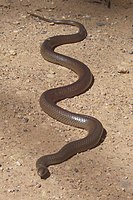
The widespread and common eastern brown ophidian is one of Australia'south most venomous elapids. Fast moving and aggressive if threatened, it is responsible for more than than one-half of the country'due south fatal bites.[38] [69]
-

Although not a particularly aggressive species, the horned viper possesses the most potent venom of all European snakes.[70] [71] It is typically regarded as the continent's most dangerous snake.[72]
-
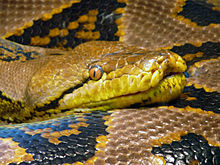
Southeast Asia'south reticulated python, the globe's largest snake, is a potentially dangerous species. More than a quarter of Aeta men (a Filipino hunter-gatherer group) take survived python predation attempts.[35]
Notes [edit]
- ^ Snakes of Medical Importance include those with highly dangerous venom resulting in high rates of morbidity and mortality, or those that are common agents in snakebite.[16]
References [edit]
- Footnotes
- ^ a b c d e f k h i j thousand l m Winkel, Ken; Kasturiratne, Anuradhani; Wickremasinghe, A. Rajitha; de Silva, Nilanthi; Gunawardena, Due north. Kithsiri; Pathmeswaran, Arunasalam; Premaratna, Ranjan; Savioli, Lorenzo; Lalloo, David One thousand; de Silva, H. Janaka (2008). "The Global Brunt of Snakebite: A Literature Analysis and Modelling Based on Regional Estimates of Envenoming and Deaths". PLOS Medicine. five (11): e218. doi:x.1371/journal.pmed.0050218. PMC2577696. PMID 18986210.
- ^ a b c d e f g Aureate, Barry Southward.; Richard C. Dart; Robert A. Barish (1 April 2002). "Bites of venomous snakes". The New England Journal of Medicine. 347 (five): 347–56. doi:10.1056/NEJMra013477. ISSN 0028-4793. PMID 12151473.
- ^ Russell, F. E. (1990). "When a snake strikes". Emerg Med. 22 (12): 33–4, 37–40, 43.
- ^ "Elapidae". Integrated Taxonomic Information Arrangement. Retrieved 27 November 2006.
- ^ "Viperidae". Integrated Taxonomic Data System. Retrieved 10 August 2006.
- ^ a b Mackessy, Stephen P. (2002). "Biochemistry and pharmacology of colubrid snake venoms" (PDF). Journal of Toxicology: Toxin Reviews. 21 (i–2): 43–83. CiteSeerX10.1.1.596.5081. doi:10.1081/TXR-120004741. S2CID 86568032. Archived from the original (PDF) on 2010-06-02. Retrieved 2009-09-26 .
Estimates of the number of venomous colubrids approach 700 species. Near may not produce a venom capable of causing serious damage to humans, just at to the lowest degree five species (Dispholidus typus, Thelotornis capensis, Rhabdophis tigrinus, Philodryas olfersii and Tachymenis peruviana) have acquired human being fatalities
- ^ Kasturiratne, A; Wickremasinghe, AR; de Silva, Due north; Gunawardena, NK; Pathmeswaran, A; Premaratna, R; Savioli, Fifty; Lalloo, DG; de Silva, HJ (4 November 2008). "The global burden of snakebite: a literature analysis and modelling based on regional estimates of envenoming and deaths". PLOS Medicine. 5 (11): e218. doi:x.1371/journal.pmed.0050218. PMC2577696. PMID 18986210.
- ^ a b Gutiérrez, José María; Bruno Lomonte; Guillermo León; Alexandra Rucavado; Fernando Chaves; Yamileth Angulo (2007). "Trends in Snakebite Envenomation Therapy: Scientific, Technological and Public Health Considerations" (PDF). Electric current Pharmaceutical Blueprint. 13 (28): 2935–50. doi:10.2174/138161207782023784. PMID 17979738. Archived from the original (PDF) on 2011-04-28. Retrieved 2009-07-01 .
- ^ Longbottom, Joshua (August 25, 2018). "Vulnerability to snakebite envenoming: a global mapping of hotspots". The Lancet. 392 (10148): 673–684. doi:x.1016/S0140-6736(18)31224-8. PMC6115328. PMID 30017551.
- ^ a b Wingert Westward, Chan L (ane Jan 1988). "Rattlesnake Bites in Southern California and Rationale for Recommended Treatment". West J Med. 148 (one): 37–44. PMC1026007. PMID 3277335.
- ^ a b c d Gutiérrez, José María; R. David G. Theakston; David A. Warrell (6 June 2006). "Confronting the Neglected Problem of Ophidian Bite Envenoming: The Need for a Global Partnership". PLOS Medicine. three (6): e150. doi:10.1371/journal.pmed.0030150. PMC1472552. PMID 16729843.
- ^ Parrish H (1966). "Incidence of treated snakebites in the U.s.". Public Health Rep. 81 (3): 269–76. doi:10.2307/4592691. JSTOR 4592691. PMC1919692. PMID 4956000.
- ^ Gold BS, Wingert WA (1994). "Serpent venom poisoning in the United States: a review of therapeutic practise". South. Med. J. 87 (half-dozen): 579–89. doi:10.1097/00007611-199406000-00001. PMID 8202764. S2CID 37771848.
- ^ a b c Mackessy 2010, p. 456
- ^ Mallow, David; David Ludwig; Goran Nilson (2004). True Vipers: Natural History and Toxinology of Former World Vipers. Malabar, FL: Krieger Publishing Company. ISBN978-0-89464-877-9.
- ^ a b WHO Adept Committee on Biological Standardization. "Guidelines for the production, control and regulation of snake antivenom immunoglobulins" (PDF). WHO Technical Report Series, No. 964. pp. 224–226. Retrieved xx July 2021.
- ^ a b c Van Der Vlies, C. (2010). Southern Africa Wildlife and Gamble. British Columbia, Canada/Indiana, U.s.: Trafford Publishing. pp. 180–181. ISBN978-1-4269-1932-nine.
- ^ a b c d e f grand h Chippaux, J.P. (1998). "Serpent-bites: appraisal of the global situation" (PDF). Message of the Globe Health Organization. 76 (five): 515–24. PMC2305789. PMID 9868843. Retrieved 2009-07-03 .
- ^ Závada, J.; Valenta J.; Kopecký O.; Stach Z.; Leden P (2011). "Black Mamba Dendroaspis Polylepis Bite: A Case Report". Prague Medical Periodical. 112 (4): 298–304. PMID 22142525.
- ^ Valenta 2010, p. xx
- ^ a b Mackessy 2010, p. 459
- ^ Greene 1997, p. 40
- ^ Christensen, PA (20 June 1981). "Snakebite and the use of antivenom in southern Africa". Due south African Medical Journal. 59 (26): 934–938. PMID 7244896.
- ^ "Immediate First Aid for bites past Blackness Mamba (Dendroaspis polylepis polylepis)". University of California at San Diego.
- ^ Visser, Chapman, John, David Due south (1978). Snakes and Snakebite: Venomous snakes and management of serpent seize with teeth in Southern Africa. Purnell. ISBN978-0-86843-011-ix.
- ^ Mackessy 2010, p. 455
- ^ Mackessy 2010, p. 468
- ^ a b c d e f Mackessy 2010, p. 454
- ^ Mackessy 2010, p. 465
- ^ Kadir, M.F.; Karmoker, J.R.; Alam, M.R.; Jahan, S.R.; Mahbub, S.; Mia, M.Thou.G. (2015). "Ethnopharmacological Survey of Medicinal Plants Used by Traditional Healers and Indigenous People in Chittagong Hill Tracts, Bangladesh, for the Treatment of Snakebite". Testify-Based Complementary and Alternative Medicine. 2015: ane–23. doi:10.1155/2015/871675. PMC4386694. PMID 25878719.
- ^ a b Simpson, I. D.; Norris, R. 50. (2007). "Snakes of Medical Importance in India: Is the Concept of the "Big 4" Still Relevant and Useful?". Wilderness and Environmental Medicine. 18 (ane): ii–nine. doi:10.1580/06-weme-co-023r1.one. PMID 17447706.
- ^ a b c Joseph, J. K.; Simpson, I. D.; Menon, N. C. S.; Jose, M. P.; Kulkarni, Thou. J.; Raghavendra, One thousand. B.; Warrell, D. A. (2007). "First authenticated cases of life-threatening envenoming by the hump-nosed pit viper (Hypnale hypnale) in India". Transactions of the Regal Guild of Tropical Medicine and Hygiene. 101 (1): 85–90. doi:ten.1016/j.trstmh.2006.03.008. PMID 16839578.
- ^ a b c Valenta 2010, p. 21
- ^ Pratanaphon, Ronachai; Surasak Akesowan; Orawan Khow; Supod Sriprapat; Kavi Ratanabanangkoon (October 1997). "Production of highly stiff horse antivenom against the Thai cobra (Naja kaouthia)". Vaccine. 15 (14): 1523–1528. doi:ten.1016/S0264-410X(97)00098-4. PMID 9330463.
- ^ a b c Headland, T. Due north.; Greene, H. W. (2011). "Hunter–gatherers and other primates as prey, predators, and competitors of snakes". Proceedings of the National University of Sciences. 108 (52): E1470–E1474. doi:10.1073/pnas.1115116108. PMC3248510. PMID 22160702.
- ^ Mackessy 2010, p. 449
- ^ a b c d e f Mackessy 2010, p. 424
- ^ a b c Mirtschin, P.J.; R. Shineb; T.J. Niasa; Northward.L. Dunstana; B.J. Hougha; K. Mirtschina (2002). "Influences on venom yield in Australian tigersnakes (Notechis scutatus) and brownsnakes (Pseudonaja textilis: Elapidae, Serpentes)" (PDF). Toxicon. twoscore (xi): 1581–92. doi:10.1016/S0041-0101(02)00175-vii. PMID 12419509. Retrieved 2009-07-03 .
- ^ Mackessy 2010, p. 425
- ^ Mackessy 2010, p. 441
- ^ a b c Chippaux, J. P. (2012). "Epidemiology of snakebites in Europe: a systematic review of the literature". Toxicon. 59 (1): 86–99. doi:10.1016/j.toxicon.2011.ten.008. PMID 22056768. S2CID 13028023.
- ^ a b Chippaux, J. P.; Saz-Parkinson, Z.; Blanco, J. M. A. (2013). "Epidemiology of snakebite in Europe: comparison of data from the literature and case reporting". Toxicon. 76: 206–213. doi:10.1016/j.toxicon.2013.10.004. PMID 24125660.
- ^ Scharper, A; Desel, H; Ebbecke, Grand; de Haro, L; Deters, M; Hentschel, H; Hermanns-Clausen, M; Langer, C (2009). "Bites and stings by exotic pets in Europe: an 11 twelvemonth analysis of 404 cases from north-eastern Germany and s-eastern French republic". Clin. Toxicol. 47 (1): 39–43. doi:10.1080/15563650801954875. PMID 18608301. S2CID 205901924.
- ^ Valenta, J; Stach, Z; Michalek, P (2014). "Exotic snake bites in the Czechia—Epidemiological and clinical aspects during 15-year period (1999–2013)". Clinical Toxicology. 52 (four): 258–264. doi:10.3109/15563650.2014.902066. PMID 24666339. S2CID 20707330.
- ^ Chew, M. S.; Guttormsen, A. B.; Metzsch, C.; Jahr, J. (2003). "Exotic snake bite: a claiming for the Scandinavian anesthesiologist?". Acta Anaesthesiologica Scandinavica. 47 (2): 226–229. doi:10.1034/j.1399-6576.2003.00049.x. PMID 12631054. S2CID 30850053.
- ^ a b Valenta 2010, p. 221
- ^ Russell, Findlay E (1983). Ophidian Venom Poisoning. Nifty Neck, NY: Scholium International. p. 163. ISBN978-0-87936-015-3.
- ^ a b Russell, Findlay E. (1980). "Snake Venom Poisoning in the Us". Annual Review of Medicine. 31: 247–59. doi:10.1146/annurev.me.31.020180.001335. PMID 6994610. S2CID 1322336.
- ^ "Venomous Snakes". February 24, 2012. Retrieved xix May 2015.
- ^ Mackessy 2010, p. 484
- ^ Mackessy 2010, p. 491
- ^ a b Mackessy 2010, p. 492
- ^ a b Mackessy 2010, p. 494
- ^ a b c d Warrell, David A. (2004). Campbell, J. A.; Lamar, Due west. W. (eds.). Snakebites in Primal and South America: Epidemiology, Clinical Features, and Management. Ithaca, New York: Comstock. pp. 709–762.
- ^ Swaroop, S.; Grab, B. (1954). "Snakebite mortality in the globe". Bulletin of the World Health Organization. 10 (i): 35–76. PMC2542029. PMID 13150169.
- ^ Otero, R; Gutiérrez, J; Mesa, Yard B; Duque, E; Rodrı́guez, O; Arango, J 50; Gómez, F; Toro, A; Cano, F; Rodrı́guez, L M; Caro, E (2002). "Complications of Bothrops, Porthidium, and Bothriechis snakebites in Colombia. A clinical and epidemiological study of 39 cases attended in a academy infirmary". Toxicon. 40 (viii): 1107–1114. doi:x.1016/S0041-0101(02)00104-6. PMID 12165312.
- ^ Hardy, D. L. (1994). "Bothrops asper (Viperidae) snakebite and field researchers in Heart America". Biotropica. 26 (2): 198–207. doi:10.2307/2388809. JSTOR 2388809.
- ^ Rosenfeld, G. (1971). Bucherl, Due west.; Buckley, E. East. (eds.). Symptomatology, pathology, and treatment of serpent seize with teeth in South America. New York: Academic Press. pp. 345–384.
- ^ Changon, Northward. A. (1968). Yanomamö: the trigger-happy people. New York: Holt, Rinehart, Winston.
- ^ Larrick, J. Westward.; Yost, J. A.; Kaplan, J. (1978). "Snakebite among the Waorani Indians of eastern Republic of ecuador". Transactions of the Royal Society of Tropical Medicine and Hygiene. 72 (5): 542–543. doi:ten.1016/0035-9203(78)90184-0. PMID 726003.
- ^ Larrick, J. Due west.; Yost, J. A.; Kaplan, J.; Male monarch, Thou.; Mayhall, J. (1979). "Patterns of health and illness among the Waorani Indians of eastern Ecuador". Medical Anthropology. 3 (ii): 147–189. doi:10.1080/01459740.1979.9965838.
- ^ Pierini, South. V.; Warrell, D. A.; de Paulo, A.; Theakston, R. D. G. (1996). "High incidence of bites and stings past snakes and other animals among rubber tappers and Amazonian Indians of the Juruá Valley, Acre Land, Brazil". Toxicon. 34 (ii): 225–236. doi:10.1016/0041-0101(95)00125-5. PMID 8711756.
- ^ Acosta-Solís, Misael (1981). Republic of ecuador in the shadow of the volcanoes. Quito, Ecuador: Ediciones Libri Mundi.
- ^ a b c d east f Phillips, Charles K. (2002). "Sea snake envenomation" (PDF). Dermatologic Therapy. 15 (1): 58–61(4). doi:ten.1046/j.1529-8019.2002.01504.x. S2CID 73275266. Retrieved 2009-07-24 .
- ^ Thomas, Craig; Susan Scott (1997). All Stings Considered: First Aid and Medical Treatment of Hawaii'south Marine Injuries. Honolulu, How-do-you-do: Academy of Hawaii Press. pp. 72–76. ISBN978-0-8248-1900-ii.
- ^ Tu, AG; Fulde GE (1987). "Body of water snake bites". Clinics in Dermatology. five (three): 118–26. doi:10.1016/S0738-081X(87)80018-4. ISSN 0738-081X. PMID 3311337.
- ^ a b Valenta 2010, p. 153
- ^ O'Shea 2008, p. 78.
- ^ O'Shea 2008, p. 115
- ^ Halassy, Beata; Brgles, Marija; Habjanec, Lidija; Balija, Maja Lang; Kurtović, Tihana; Marchetti-Deschmann, Martina; Križaj, Günter; Allmaier, Igor (2010). "Intraspecies variability in Vipera ammodytes ammodytes venom related to its toxicity and immunogenic potential". Comparative Biochemistry and Physiology C. 153 (2): 223–230. doi:ten.1016/j.cbpc.2010.ten.007. PMID 20971215.
- ^ Valenta 2010, p. 186
- ^ O'Shea 2008, p. 57
- ^ O'Shea 2008, p. 46
- ^ O'Shea 2008, p. 40
- Bibliography
- Greene, Harry W. (1997). Snakes: The Evolution of Mystery in Nature . Berkeley, CA: Academy of California Press. ISBN978-0-520-20014-ii.
- Mackessy, Stephen P., ed. (2010). Handbook of Venoms and Toxins of Reptiles (second ed.). Boca Raton, FL: CRC Press. ISBN978-0-8493-9165-1.
- O'Shea, Mark (2008). Venomous Snakes of the World. London: New Holland Publishers. ISBN978-1-84773-086-two.
- Valenta, Jiri (2010). Venomous Snakes: Envenoming, Therapy (2d ed.). Hauppauge, NY: Nova Science Publishers. ISBN978-1-60876-618-5.
Source: https://en.wikipedia.org/wiki/Epidemiology_of_snakebites
Posted by: doyletandinque.blogspot.com
0 Response to "What Animal Has The Highest Mortality Rate"
Post a Comment