

What Is The Advantage Of Radial Symmetry For Sessile Animals
While scientists are even so trying to determine the different ways that bilateral symmetry in animals is advantageous, the most obvious benefit is that it enhances an animal'southward mobility. It allows fluid movement in a particular management, which helps when an animal is searching for food or trying to escape danger.
All vertebrates have bilateral symmetry likewise as some invertebrates. Bilateral symmetry refers to both sides of the body being a mirror epitome of each other when viewed across a central axis. On either side of the primal centrality, the arrangement of an creature'south body parts is the same. This but applies to the body shape, not the internal organs.
What Is a Sagittal Airplane?
To explain bilateral symmetry, an imaginary line tin be drawn along the length of an animal. Starting at the tip of its olfactory organ and ending at the tip of the tail, this line splits the trunk into 2 halves. The left side and right side mirror each other, and the line that divides these halves is chosen the sagittal plane. In most animals, the sagittal plane runs horizontally. However, in humans, it runs vertically because of our upright orientation.
Despite this left and right symmetry, the two halves aren't necessarily identical. For instance, a whale might have a slightly bigger flipper on one side than on the other.
What Are the Primary Advantages of Bilateral Symmetry?
Animals with bilateral symmetry accept greater motion capabilities in a item direction. Their bodies are also streamlined, which is very beneficial for some animals, such as marine animals, as it allows for motion at a faster speed.
The sensory organs are all clustered in the caput, which is called cephalization. Equally forward motion is used to travel, this ways an animal'south head meets and reacts to stimuli before the balance of the trunk. As a issue, the hearing and eyesight of animals with bilateral symmetry are more enhanced than in animals displaying radial symmetry.
What Other Characteristics Are In that location?
Animals with bilateral symmetry all have a caput (anterior) and a tail (posterior) area, a left and right side, and a top (dorsal) and lesser (ventral). The majority have a cardinal nervous organization with a complex brain and facial features that include a oral cavity and two eyes. A benefit of having a split up tail and head area is that nutrient is consumed at i cease of the trunk and waste is excreted at the other cease.
Bilateral symmetry helps animals move easily in a forward direction and helps animals keep their residual. For example, a lioness with 4 normal legs can run and chase efficiently whereas i that has been injured and has a damaged paw or limb is at a disadvantage when trying to practice either action.
Examples of Animals With Bilateral Symmetry
Bilateral symmetry, which is also called aeroplane symmetry, exists in 99 percent of animals. Most phyla are included in this, such as Arthropoda, Annelida, Chordata, Nematoda, Platyzoa, and the majority of Mollusca.
Therefore, likewise as humans and marine mammals, such as whales, examples of animals with bilateral symmetry include cats, dogs, mice, bears, elephants, crabs, wolves, frogs, birds, giraffes, and badgers.
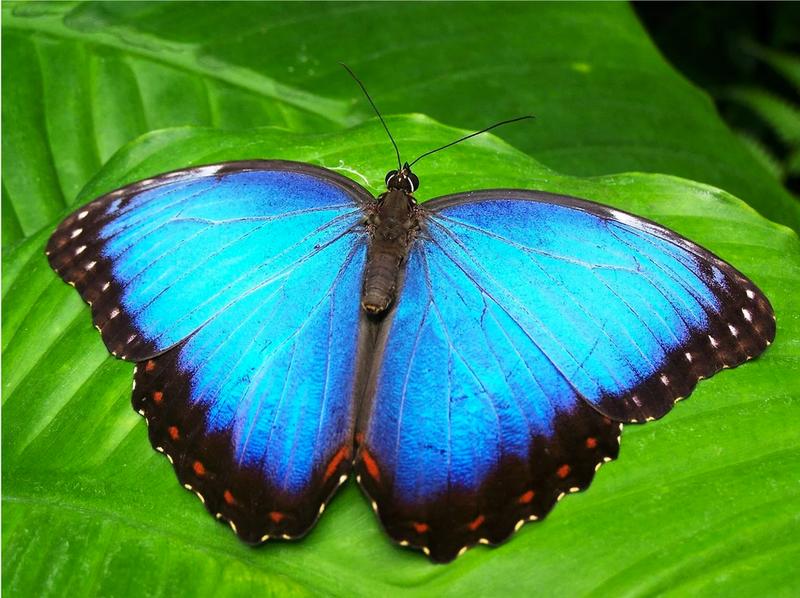
Butterflies have exceptional bilateral symmetry. Too as having a symmetrical body shape, the patterns on their wings are about identical.
What Is Radial Symmetry?
The other main type of symmetry in animals is called radial symmetry. This means an animal has numerous axes passing through the middle of the torso with equal halves displayed forth any of the axes. They can move in any direction as opposed to the forward move favored by animals with bilateral symmetry. A starfish has radial symmetry, every bit does a jellyfish.
These animals move slowly and have sensory organs dotted around rather than stock-still in a fundamental nervous system. They have a top and a bottom as well equally an oral side (including a mouth) and an aboral side (without a mouth).
Animals with radial symmetry can regenerate parts of their bodies. For example, if a sea star loses an arm, it tin can grow a new one.
Exceptions to Bilateral and Radial Symmetry
Some animals have biradial symmetry or pentaradial symmetry. Biradial combines both bilateral and radial symmetry. The body has iv sections beyond a central centrality, and each of these is the aforementioned as the one opposite information technology but different from the 1 next to it. Pentaradial has five sections, which are all equal, such as in sea urchins and sand dollars. Echinoderms are special because they start life with bilateral symmetry and then switch to pentaradial symmetry as adults. Some animals don't fall into whatsoever of these categories as they are asymmetrical, such as sponges.
Source: https://www.reference.com/science/advantages-bilateral-symmetry-animals-9224fa1fea57d185
Posted by: doyletandinque.blogspot.com
0 Response to "What Is The Advantage Of Radial Symmetry For Sessile Animals"
Post a Comment